
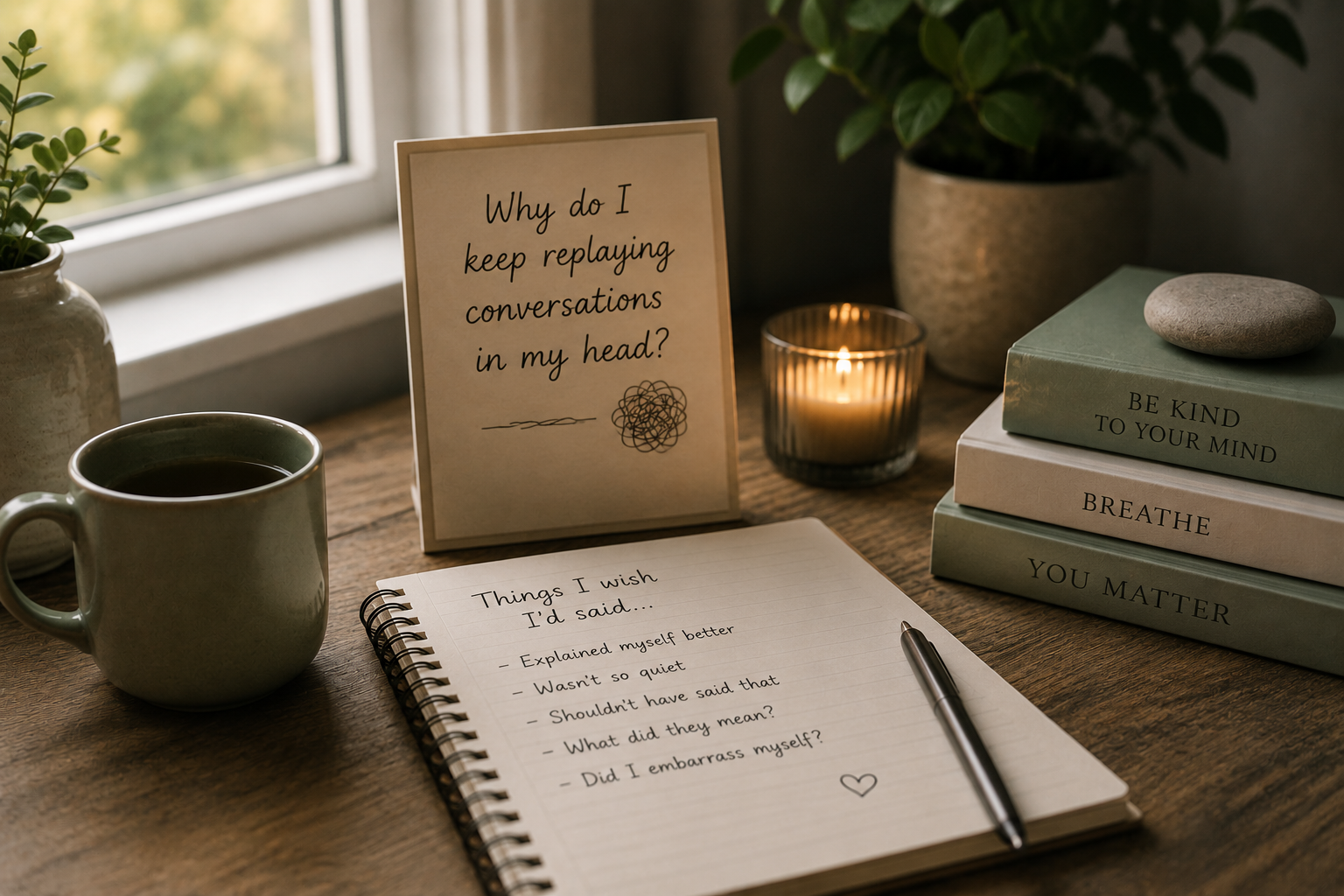
Why Do I Keep Replaying Conversations in My Head?
By Richard McQuirke
Have you ever walked away from a conversation and then spent the next few hours going over it again and again in your head?
Why did I say that?
What did they mean when they said that?
Did I come across badly?
I should have said something different.
I wonder if they're annoyed with me.
Sometimes the conversation might have lasted five minutes, but the version taking place in your head can carry on for hours, or even days.
If this sounds familiar, you're certainly not alone.
Why do we replay conversations?
Our minds naturally try to make sense of things that happen to us. After an uncomfortable, emotional or uncertain conversation, your brain may go back over what happened in an attempt to understand it.
Sometimes that's useful.
You might reflect on something you said, realise you could have handled it differently and decide what you would like to do next time.
But there's a difference between reflection and getting stuck in a loop.
When you find yourself repeatedly going over the same conversation without reaching any new conclusion, this is sometimes called rumination.
Instead of helping you solve the problem, your mind keeps returning to it.
And every time it does, you can experience some of the uncomfortable feelings all over again.
The endless "I should have said..." conversation
Most of us are much better at conversations several hours after they've finished.
Suddenly you know exactly what you should have said.
You think of the perfect response in the shower, while driving home or at three o'clock in the morning.
The problem is that you're judging what you said then using everything you know now.
In the actual moment, perhaps you were nervous, angry, embarrassed, surprised or simply didn't know what to say.
That's human.
We don't get to pause real-life conversations while we carefully work out the perfect response.
Sometimes we're trying to read somebody else's mind
Another reason conversations can stay with us is uncertainty.
Perhaps someone's tone seemed different.
Maybe their reply was shorter than usual.
Perhaps they didn't respond in the way you expected.
When we don't know what somebody else was thinking, our minds can be very good at filling in the gaps.
Unfortunately, those gaps aren't always filled with reassuring explanations.
They must think I'm stupid.
I've upset them.
They don't like me.
I've made a fool of myself.
But there is an important distinction here.
What you know and what you fear are not necessarily the same thing.
Someone being quiet could mean they're annoyed with you.
It could also mean they're tired, distracted, worried about something completely unrelated or simply having a difficult day themselves.
We rarely have access to everything happening in another person's world.
Self-criticism can keep the loop going
Sometimes the conversation isn't really the biggest problem.
It's what we say to ourselves afterwards.
You might notice that your internal voice is far harsher than anything the other person actually said.
That was stupid.
Why am I always like this?
I always get things wrong.
If you already tend to doubt yourself, worry about what others think or put pressure on yourself to get things right, an ordinary conversation can become evidence for a much bigger story you tell yourself.
One awkward moment becomes "I'm terrible with people."
One disagreement becomes "Nobody listens to me."
One mistake becomes "I always mess things up."
That can be exhausting.
Anxiety likes certainty
Anxiety often struggles with unanswered questions.
It wants to know:
Are we okay?
Did I say the right thing?
What do they think of me?
Is something bad going to happen because of this?
So your mind keeps returning to the conversation, hoping that one more replay will finally provide certainty.
But sometimes there simply isn't any more information available.
Replaying the conversation for the twentieth time doesn't necessarily bring you any closer to knowing what the other person was thinking.
It just keeps you inside the conversation.
How can I stop replaying it?
Telling yourself "just stop thinking about it" usually isn't particularly helpful.
Instead, it can be useful to notice what's happening.
You might ask yourself:
Am I learning anything new by thinking about this again?
If the answer is no, you may have moved from reflection into rumination.
Try separating what you know from what you are assuming.
What was actually said?
What happened?
And what have you added afterwards because you're worried about what it might have meant?
You could also ask yourself what you would say to somebody you cared about if they were worrying about the same conversation.
We often offer other people far more understanding than we offer ourselves.
And if there genuinely is something you wish you'd handled differently, perhaps the question isn't "Why did I do that?" but:
"What would I like to do differently next time?"
That turns the conversation from something you repeatedly punish yourself with into something you can learn from.
You don't have to solve every conversation
Some conversations will remain awkward.
Sometimes you'll say something you wish you'd phrased differently.
Sometimes another person won't respond in the way you hoped.
And sometimes you'll never know exactly what somebody else thought.
That's part of being human.
The aim isn't to never think about a conversation again. Reflection can be healthy and useful.
The difficulty comes when your mind won't let the conversation finish.
When your mind won't switch off
If you regularly find yourself replaying conversations, worrying about what people think, second-guessing yourself or lying awake analysing things that happened during the day, it may be worth exploring what's underneath that.
Sometimes it isn't really about that one conversation.
It may be connected to anxiety, confidence, self-esteem, previous experiences or the expectations you place on yourself.
Counselling can provide a space to explore those patterns without judgement and begin to understand why certain situations affect you in the way they do.
You don't need to wait until things become unbearable before talking to someone.
Sometimes it simply starts with noticing:
"My mind seems to be carrying this around a lot."
And perhaps giving yourself somewhere to put it down.
McQuirke Counselling
Online and telephone counselling for adults experiencing anxiety, stress, burnout, workplace pressure and life changes.
Free 15-minute initial consultation
If you'd like to find out whether counselling might be right for you, you're welcome to get in touch.